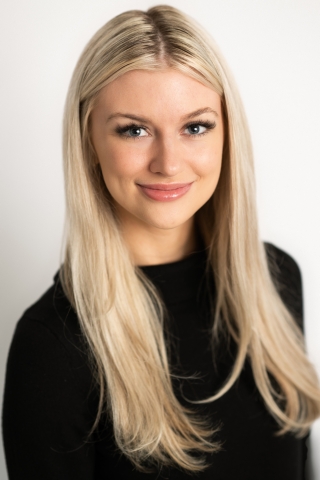
Anyone who wants to become a Navy pilot must meet several criteria and pass multiple tests.
“My virtual reality research explores physiological and cognitive abilities that may provide insights for future pilot selection and training, help mitigate a lot of the safety and cost barriers involved in selection and training for high-risk environments like aviation, or training with firefighters, or any type of first responder,” ARCS Scholar Allison Bayro says. “We don’t necessarily have to put them in harm’s way to give them the training they need.”
A Phoenix Chapter ARCS Scholar at Arizona State University, Bayro worked in the lab of Dr. Heejin-Jeong, which focuses on human systems engineering. Bayro’s work in understanding the psychophysiological profiles of individuals in virtual reality is what connected her to the Naval Research Laboratory (NRL). About a year into her ASU program, the lab, in Washington D.C., reached out with interest in her research.
“I completed a summer internship in 2023, in D.C., under the Naval Research Enterprise Research Program. That’s what really ignited this relationship with NRL and has continued since,” Bayro explains.
The team Bayro worked with that summer was multifaceted.
“They address a lot of different naval selection, training and human-systems challenges and research areas,” she says.
Bayro’s role focused on analyzing and interpreting physiological indicators and patterns related to performance during computer-based cognitive tests. The internship sparked the idea of incorporating virtual reality tools to evaluate potential pilot abilities.
“The best place for me to take this on would be Pensacola, Florida, at the Naval Air Station,” she says. “I received access to a great population of candidates and subject-matter experts, so I was able to develop and test a virtual reality flight simulation, which required participants to navigate through terrain and perform tasks based on naval objectives.”
The advancement in virtual reality impresses Bayro.
“Truly, you can put on these goggles and sometimes not see the difference from the real world. In some of these technologies, it’s human-eye resolution at this point. It has so much potential, especially in fields like aviation,” she says.
Her aviator testing goals focused on methods to evaluate pilot spatial ability and situational awareness.
“Being able to feel like you’re in a cockpit but not actually flying a plane is an impressive experience with VR. Virtual reality proves to be a good use case in this application,” she says.
Bayro began her PhD work in biomedical engineering at the University of Illinois at Chicago.
“I realized it was the innovative research, exploring how technology can better support people, that interested me the most,” she says. “I like to problem solve; I like critical thinking.”
Two years into her PhD program, her advisor, Dr. Jeong, took a new position at Arizona State University, and Bayro followed.
“I think it was the best decision I could have made,” she said.
Her advisor’s work at ASU focused on human system engineering.
“I got to see an interdisciplinary twist – being very medical heavy, then starting to apply and see it from a human systems perspective,” she says.
That’s when Bayro began exploring how virtual reality could be applied to human systems research questions and challenges. In the final stages of her PhD dissertation, Bayro is grateful for the support from the ARCS Phoenix Chapter, which helped to fund her travel and expenses for her research.