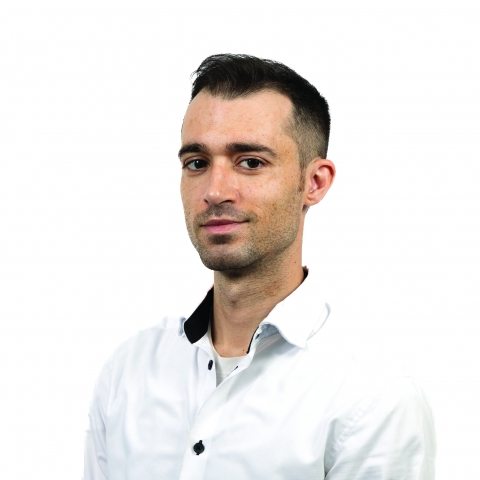
Much of what shapes an ecosystem happens underground—out of sight and, until recently, largely out of reach for scientists. Chris Vito, a PhD candidate in Environmental Life Sciences at Arizona State University, is focused on bringing that hidden world into clearer view.
“I study ecosystem ecology, which means thinking about ecosystems at a really large scale and how energy and resources move through them,” Vito explains. “We know a lot about what’s happening above ground, but we know much less about what’s happening below ground, even though that’s where most of the biomass actually is in many ecosystems.”
The ARCS Phoenix Scholar’s research centers on dryland ecosystems, dry sub-humid to hyper-arid landscapes that cover nearly half of the Earth’s land surface. These regions support a significant share of global agriculture and human populations and are especially sensitive to climate change.
“Water is the most limiting resource in drylands,” he says. “So changes in rainfall patterns can have really big effects on how these ecosystems function.”
Working at a long-term ecological research site in the Southwest, Vito studies experimental plots that have experienced 20 years of reduced rainfall, normal conditions, or increased precipitation. While researchers have decades of data on aboveground plant growth, belowground processes—especially root growth—remain poorly understood.
“To really understand how ecosystems respond to climate change, we need to know how roots respond over long periods of time,” Vito says.
To address this challenge, he combines traditional soil sampling with underground camera systems that capture images of plant roots throughout the growing season.
“We have tens of thousands of root images,” he explains. “Using machine learning tools allows us to analyze those images efficiently and translate what we see into estimates of belowground biomass.”
The result is one of the most comprehensive efforts to directly measure belowground plant production over large spatial and temporal scales.
“This gives us a much clearer picture of how carbon is stored below ground and how that storage might change with climate change,” Vito says.
Vito’s journey to this work was anything but straightforward. Raised in a dense, urban area outside Philadelphia, he had little exposure to academic science careers.
“I didn’t know anyone with a PhD,” he says. “I didn’t even realize that science could be a job like this.”
After starting college in engineering, Vito discovered his passion for ecology through coursework, field research, and museum-based scientific work. Mentorship and hands-on experience helped him realize that pursuing a PhD was both possible and sustainable.
Support from ARCS has been critical.
“A lot of my fieldwork requires upfront, out-of-pocket expenses,” he says. “The ARCS award has made that so much easier. It’s reduced financial stress and allowed me to focus on the science.”
Just as importantly, he adds, “It’s incredibly validating to know that donors believe this work matters.”